Education
-
 University of Minnesota, Minnesota, USSep. 2022 - PresentPh.D. in Electical Engineering
Minor in Computer Science -
 University of Tehran, Tehran, IranSep. 2017 - Sep. 2021B.Sc. in Electical Engineering
Honors & Awards
-
ISMRM Trainee Educational Stipend Award2026
-
IEEE EMBC NextGen Scholar Award2024
-
Leo and Bell Yau Fellowship2022
Selected Publications (view all )
Training-Free Adversarial Robustness in Computational MRI
Mahdi Saberi, Chi Zhang, Mehmet Akçakaya
International Conference on Machine Learning (ICML) 2026 Provisional Patent
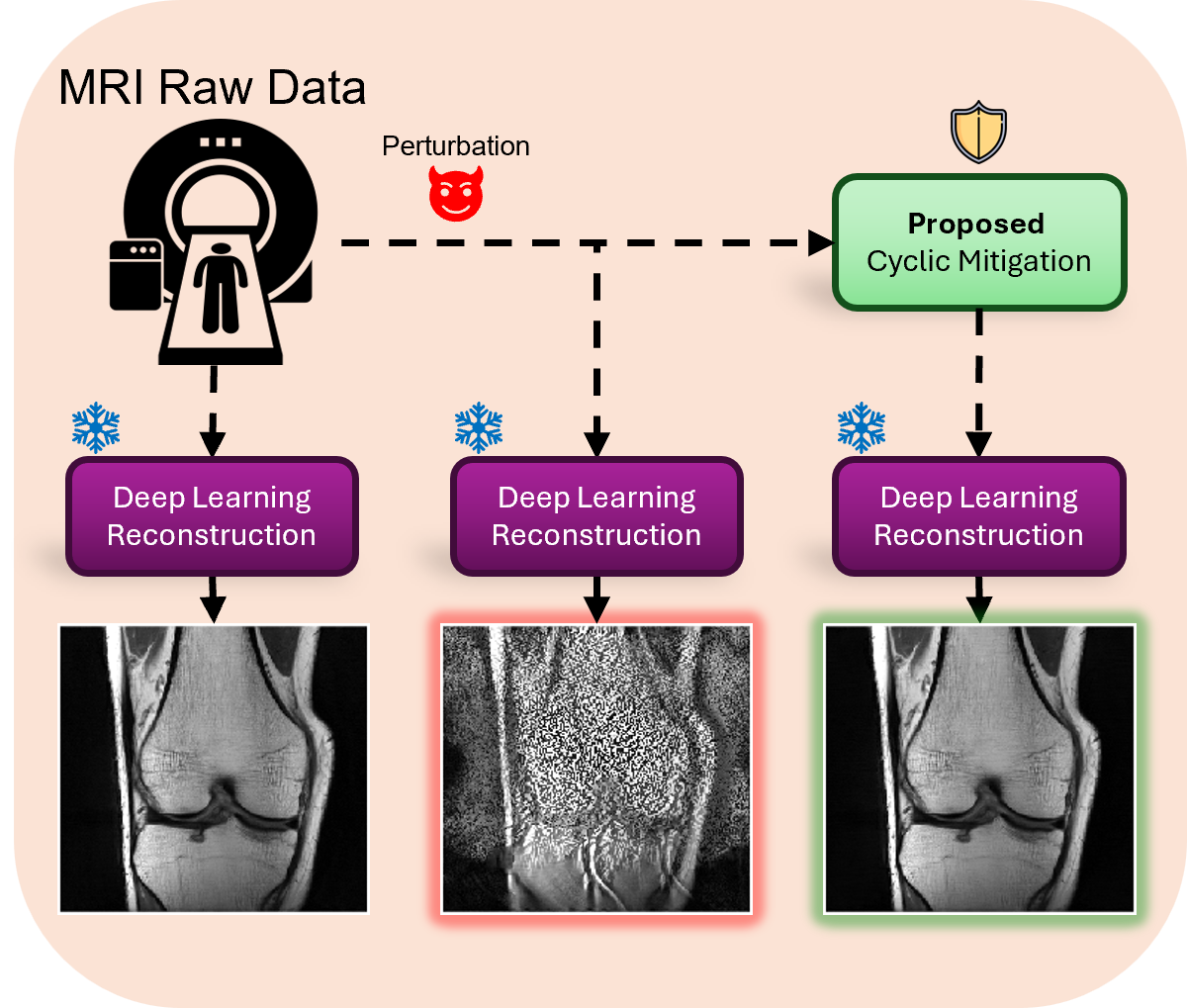
Addressed the vulnerability of PD-DL MRI reconstruction to imperceptible adversarial perturbations by developing a training-free test-time optimization framework based on cyclic measurement consistency. Outperformed state-of-the-art training-free and training-based defenses by average gains of 6.83 dB (23.6%) and 1.77 dB (5.2%) in PSNR, and 0.12 (14.7%) and 0.02 (2.2%) in SSIM, respectively, across knee and brain MRI. Validated across blind $\ell_{\infty}$ and $\ell_2$ attacks without a predefined perturbation budget, supervised attacks, suboptimal and mismatched reconstruction settings, nonuniform undersampling, k-space perturbations, and image inpainting.
Training-Free Adversarial Robustness in Computational MRI
Mahdi Saberi, Chi Zhang, Mehmet Akçakaya
International Conference on Machine Learning (ICML) 2026 Provisional Patent
Addressed the vulnerability of PD-DL MRI reconstruction to imperceptible adversarial perturbations by developing a training-free test-time optimization framework based on cyclic measurement consistency. Outperformed state-of-the-art training-free and training-based defenses by average gains of 6.83 dB (23.6%) and 1.77 dB (5.2%) in PSNR, and 0.12 (14.7%) and 0.02 (2.2%) in SSIM, respectively, across knee and brain MRI. Validated across blind $\ell_{\infty}$ and $\ell_2$ attacks without a predefined perturbation budget, supervised attacks, suboptimal and mismatched reconstruction settings, nonuniform undersampling, k-space perturbations, and image inpainting.
Revisiting MRI Reconstruction Using a Combination of Complex and Magnitude Measurements with Learned Priors
Mahdi Saberi, Mehmet Akçakaya
IEEE International Symposium on Biomedical Imaging (ISBI) 2026 Invited to IEEE TBME (Top 3–5%)
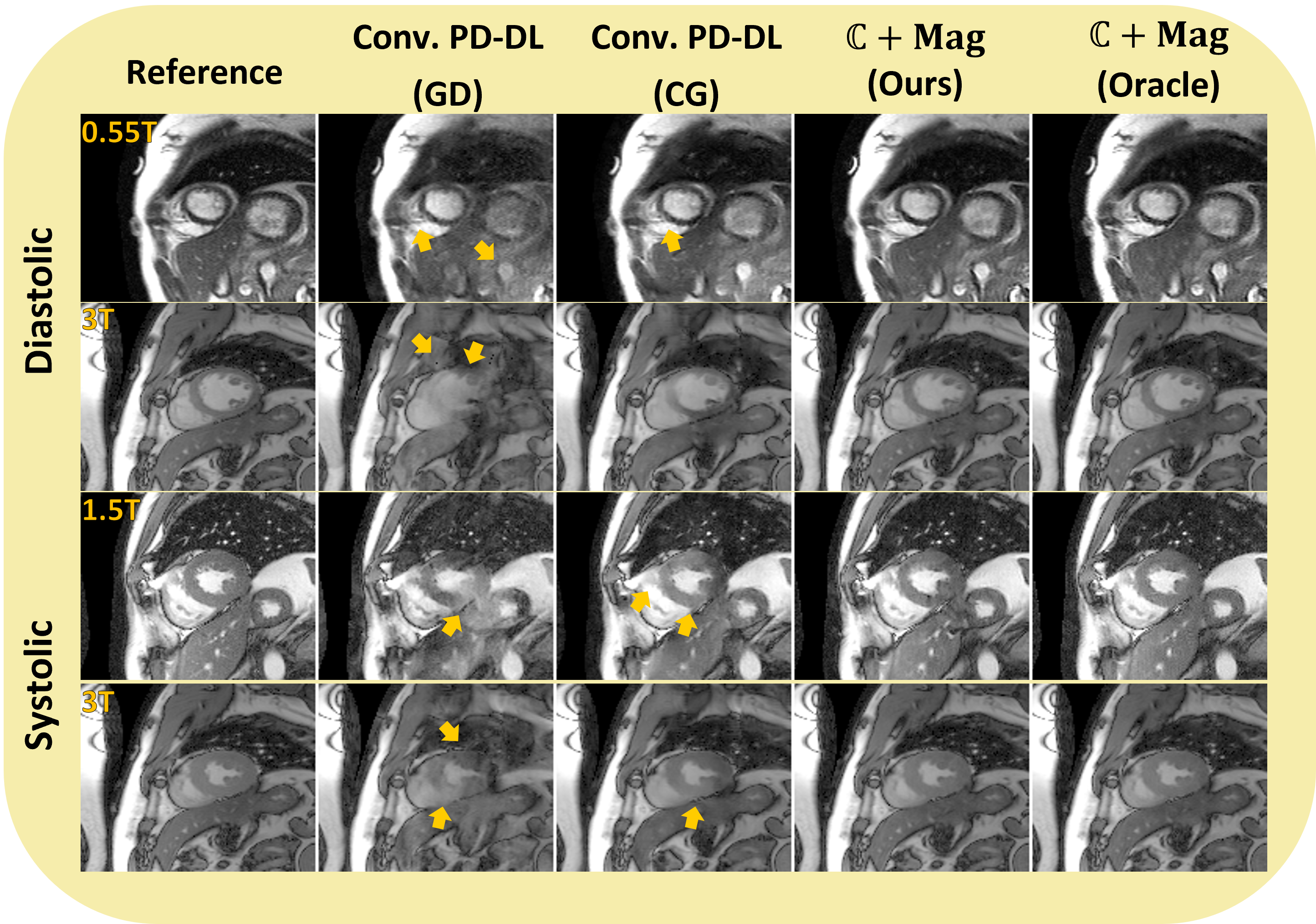
Addressed residual artifacts in highly accelerated dynamic MRI by developing C+Mag, an ADMM-unrolled framework that integrates complementary k-space magnitude information from neighboring cardiac phases through a novel magnitude-aware data-fidelity term without additional acquisition. Across retrospectively undersampled cine and Flow2D MRI at R $\in$ {6,8}, improved conventional PD-DL by an average of 7.42 dB (26.1%) in PSNR and 0.131 (16.3%) in SSIM. On prospectively undersampled real-time cine MRI at R = 8, conducted clinical image review in Synedra and cardiac functional analysis using Segment CMR, demonstrating preserved functional measurements and achieved expert-rated image quality comparable to fully sampled and clinical R = 4 references.
Revisiting MRI Reconstruction Using a Combination of Complex and Magnitude Measurements with Learned Priors
Mahdi Saberi, Mehmet Akçakaya
IEEE International Symposium on Biomedical Imaging (ISBI) 2026 Invited to IEEE TBME (Top 3–5%)
Addressed residual artifacts in highly accelerated dynamic MRI by developing C+Mag, an ADMM-unrolled framework that integrates complementary k-space magnitude information from neighboring cardiac phases through a novel magnitude-aware data-fidelity term without additional acquisition. Across retrospectively undersampled cine and Flow2D MRI at R $\in$ {6,8}, improved conventional PD-DL by an average of 7.42 dB (26.1%) in PSNR and 0.131 (16.3%) in SSIM. On prospectively undersampled real-time cine MRI at R = 8, conducted clinical image review in Synedra and cardiac functional analysis using Segment CMR, demonstrating preserved functional measurements and achieved expert-rated image quality comparable to fully sampled and clinical R = 4 references.
UMPIRE-Net: Unrolled Magnitude–Phase Regularization Network for Accelerated MRI
Mahdi Saberi, Toygan Kiliç, Mehmet Akçakaya
IEEE International Workshop on Machine Learning for Signal Processing (MLSP) 2026
International Society for Magnetic Resonance in Medicine (ISMRM) 2026
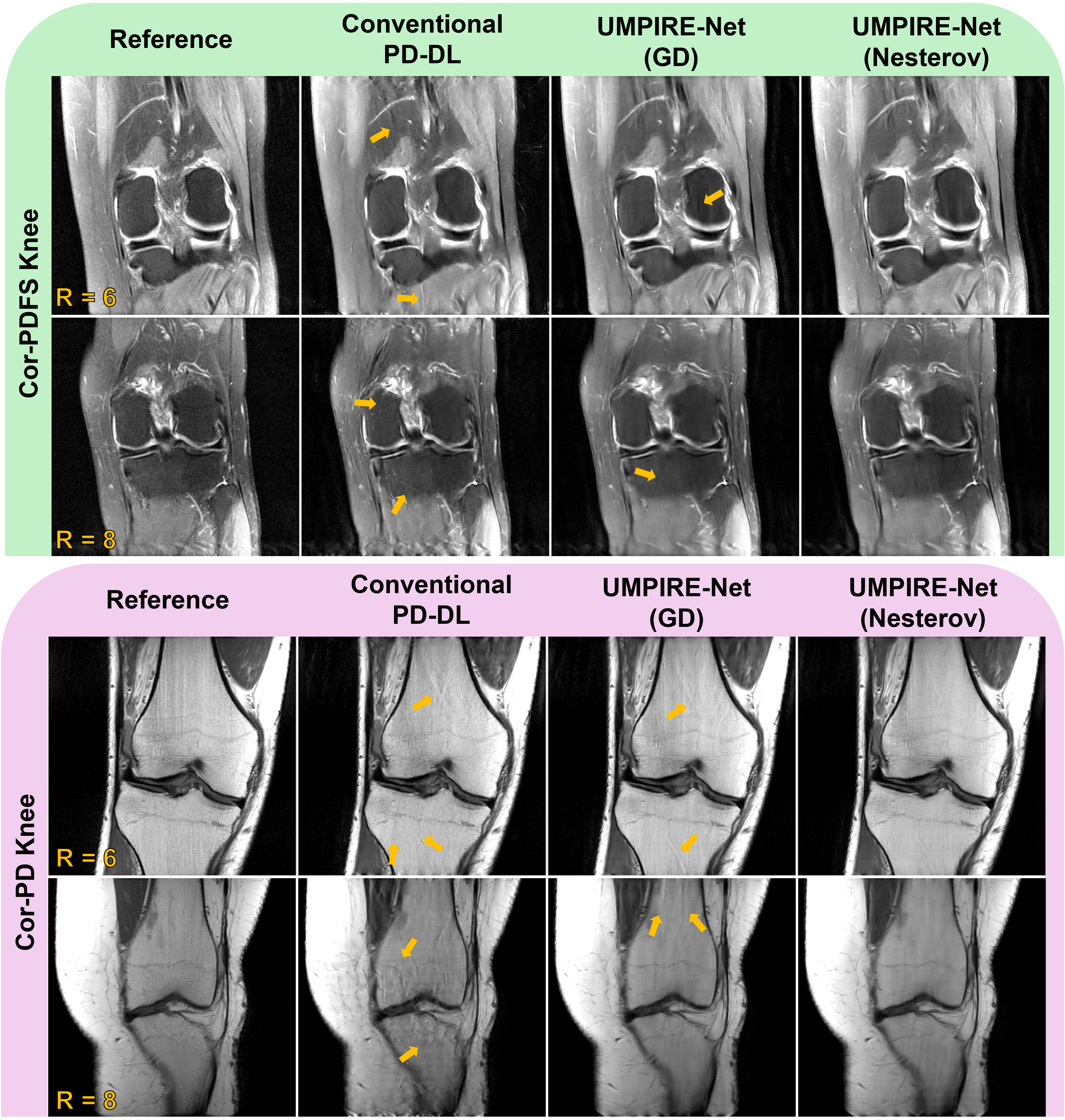
Addressed limitations of conventional complex-valued PD-DL under substantial phase variations by developing UMPIRE-Net, an ADMM-unrolled framework with separate learned magnitude and phase regularizers. Derived a novel differentiable solver for the resulting nonconvex data-fidelity objective using CR-calculus and smooth magnitude approximations, accelerated with Nesterov momentum. Achieved average gains over conventional PD-DL baselines of 1.51 dB in PSNR (4.5%) and 0.028 in SSIM (3.3%) across Cor-PD and Cor-PDFS knee datasets at R $\in$ {6,8}. This paper received the Trainee Educational Stipend Award for this work at the ISMRM 2026 Annual Meeting.
UMPIRE-Net: Unrolled Magnitude–Phase Regularization Network for Accelerated MRI
Mahdi Saberi, Toygan Kiliç, Mehmet Akçakaya
IEEE International Workshop on Machine Learning for Signal Processing (MLSP) 2026
International Society for Magnetic Resonance in Medicine (ISMRM) 2026
Addressed limitations of conventional complex-valued PD-DL under substantial phase variations by developing UMPIRE-Net, an ADMM-unrolled framework with separate learned magnitude and phase regularizers. Derived a novel differentiable solver for the resulting nonconvex data-fidelity objective using CR-calculus and smooth magnitude approximations, accelerated with Nesterov momentum. Achieved average gains over conventional PD-DL baselines of 1.51 dB in PSNR (4.5%) and 0.028 in SSIM (3.3%) across Cor-PD and Cor-PDFS knee datasets at R $\in$ {6,8}. This paper received the Trainee Educational Stipend Award for this work at the ISMRM 2026 Annual Meeting.
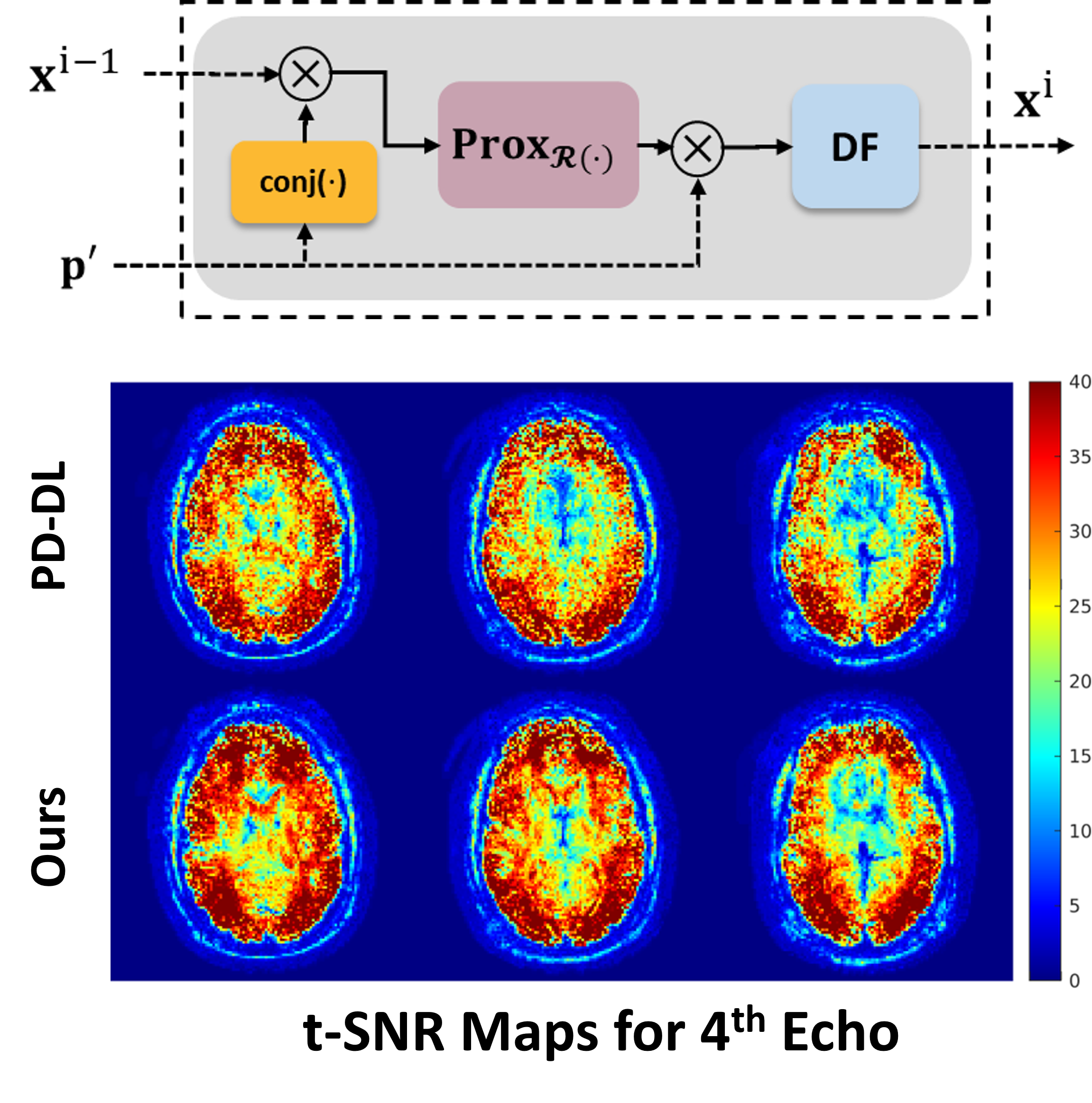
Phase-Correction Strategies for Physics-Driven Deep Learning Reconstruction of Accelerated Non-Cartesian Multi-Echo fMRI
Mahdi Saberi, Zidan Yu, Christoph Rettenmeier, Andrew Stenger, Mehmet Akçakaya
IEEE International Symposium on Biomedical Imaging (ISBI) 2026
International Society for Magnetic Resonance in Medicine (ISMRM) 2026
Addressed and mitigated echo-dependent phase inconsistencies in prospectively undersampled data by removing and restoring a low-pass-filtered phase estimate within each unrolled iteration, outperforming conventional PD-DL in anatomical recovery and tSNR at R= 6.
Phase-Correction Strategies for Physics-Driven Deep Learning Reconstruction of Accelerated Non-Cartesian Multi-Echo fMRI
Mahdi Saberi, Zidan Yu, Christoph Rettenmeier, Andrew Stenger, Mehmet Akçakaya
IEEE International Symposium on Biomedical Imaging (ISBI) 2026
International Society for Magnetic Resonance in Medicine (ISMRM) 2026
Addressed and mitigated echo-dependent phase inconsistencies in prospectively undersampled data by removing and restoring a low-pass-filtered phase estimate within each unrolled iteration, outperforming conventional PD-DL in anatomical recovery and tSNR at R= 6.
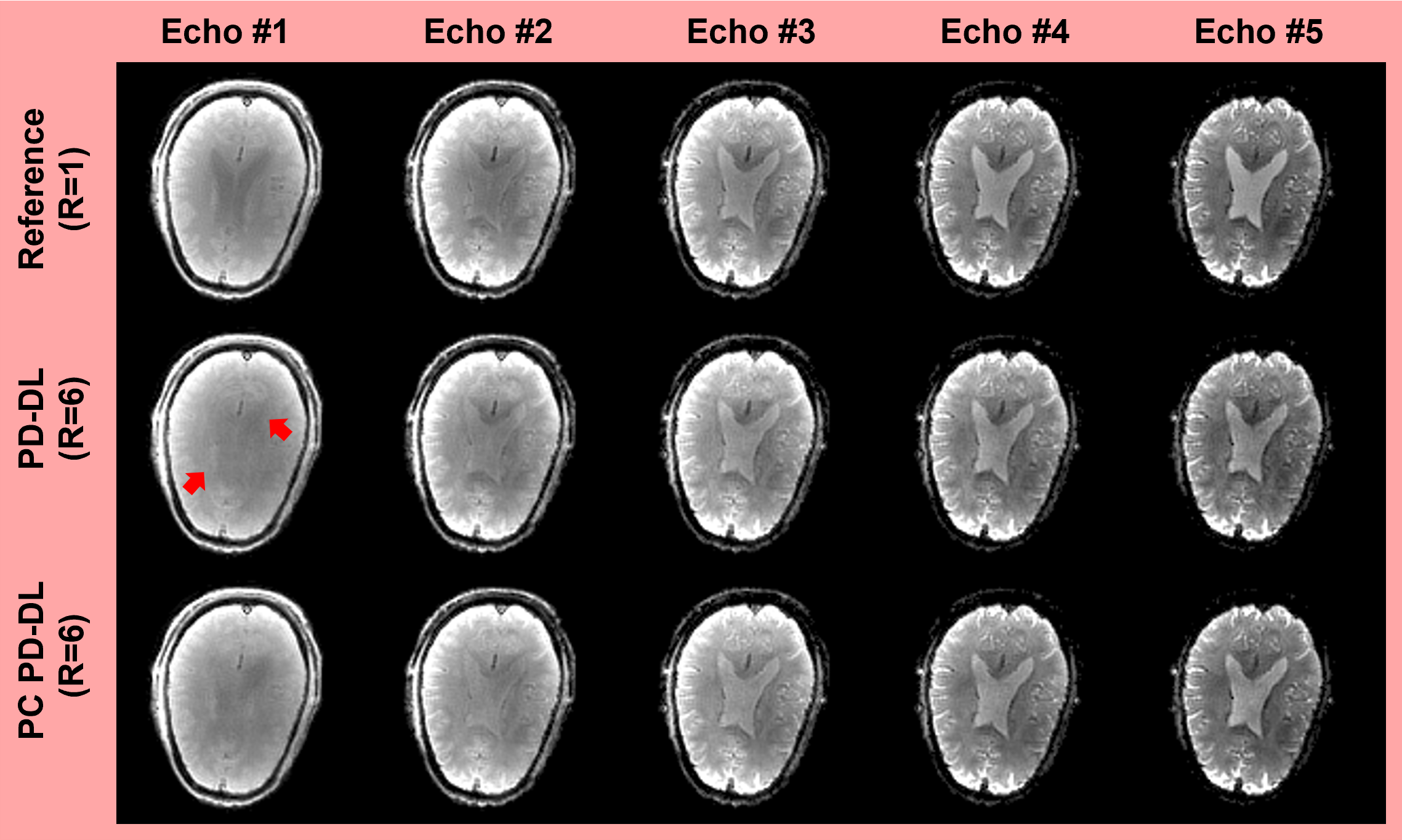
Phase-Crrected Physics-Driven Deep Learning MRI Reconstruction on Non-Cartesian Multi-Echo MRI
Mahdi Saberi, Zidan Yu, Christoph Rettenmeier, Andrew Stenger, Mehmet Akçakaya
Magnetic Resonance in Madison Workshop 2025
Addressed echo-dependent phase variations in highly accelerated non-Cartesian multi-echo fMRI by incorporating a dedicated phase-estimation network into a self-supervised PD-DL framework. Improved anatomical recovery over conventional PD-DL in retrospectively undersampled spiral acquisitions at R = 6.
Phase-Crrected Physics-Driven Deep Learning MRI Reconstruction on Non-Cartesian Multi-Echo MRI
Mahdi Saberi, Zidan Yu, Christoph Rettenmeier, Andrew Stenger, Mehmet Akçakaya
Magnetic Resonance in Madison Workshop 2025
Addressed echo-dependent phase variations in highly accelerated non-Cartesian multi-echo fMRI by incorporating a dedicated phase-estimation network into a self-supervised PD-DL framework. Improved anatomical recovery over conventional PD-DL in retrospectively undersampled spiral acquisitions at R = 6.
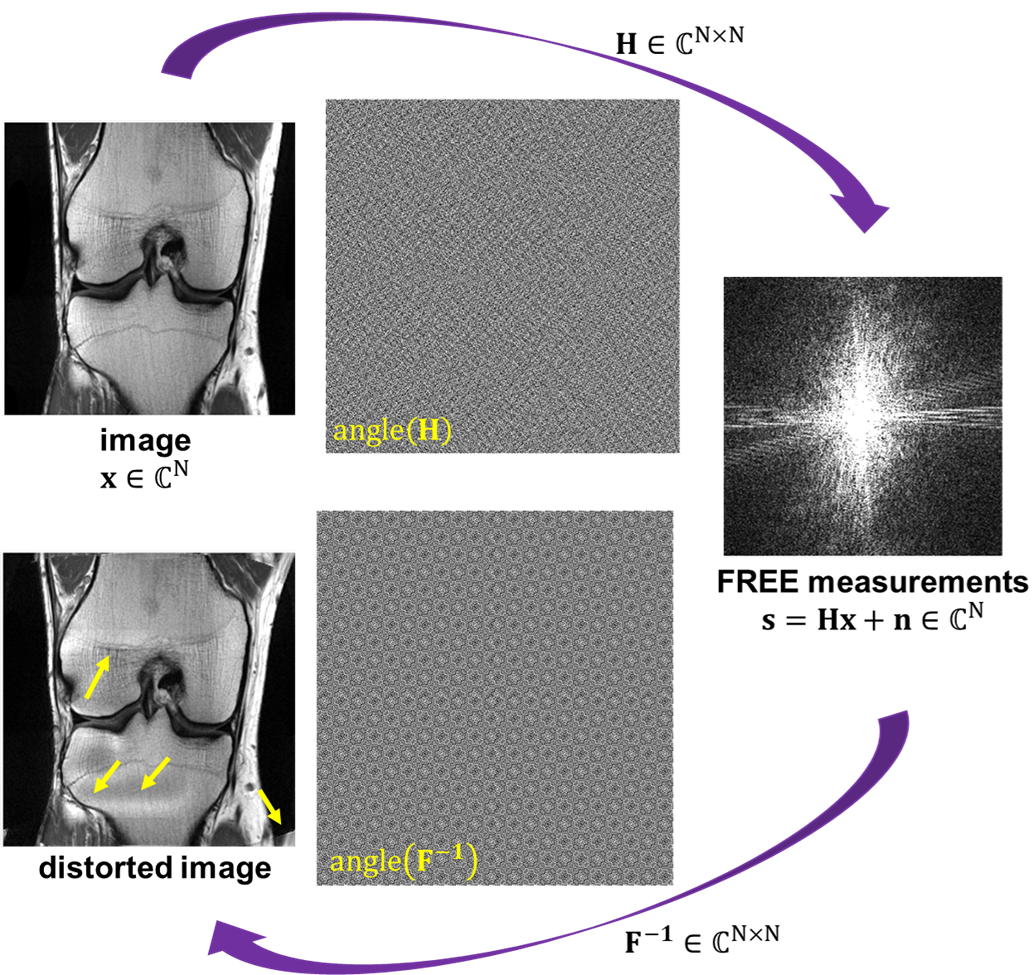
Physics-Driven Deep Learning Reconstruction of Frequency-Modulated Rabi-Encoded Echoes for Faster Accessible MRI
Mahdi Saberi, Parker Jenkins, Michael Garwood, Mehmet Akçakaya
IEEE Engineering in Medicine and Biology Conference (EMBC) 2024 Non-provisional Patent
Addressed nonlinear phase distortions and slow acquisition in RF-encoded MRI by incorporating the Frequency-Modulated Rabi-Encoded Echoes (FREE) forward model into an unrolled PD-DL framework. Demonstrated the first parallel-transmit acceleration for MRI, enabling four-fold acceleration with a single receive coil and outperforming conjugate-gradient reconstruction at R = 4 by 11.07 dB (43.7%) in PSNR and 0.29 (47.5%) in SSIM, with a projected 75% reduction in scan time. This paper received the NextGen Scholar Award from EMBC 2024.
Physics-Driven Deep Learning Reconstruction of Frequency-Modulated Rabi-Encoded Echoes for Faster Accessible MRI
Mahdi Saberi, Parker Jenkins, Michael Garwood, Mehmet Akçakaya
IEEE Engineering in Medicine and Biology Conference (EMBC) 2024 Non-provisional Patent
Addressed nonlinear phase distortions and slow acquisition in RF-encoded MRI by incorporating the Frequency-Modulated Rabi-Encoded Echoes (FREE) forward model into an unrolled PD-DL framework. Demonstrated the first parallel-transmit acceleration for MRI, enabling four-fold acceleration with a single receive coil and outperforming conjugate-gradient reconstruction at R = 4 by 11.07 dB (43.7%) in PSNR and 0.29 (47.5%) in SSIM, with a projected 75% reduction in scan time. This paper received the NextGen Scholar Award from EMBC 2024.